Bid on this Item
Showing posts with label England. Show all posts
Thursday, May 20, 2010
Bath England 1790
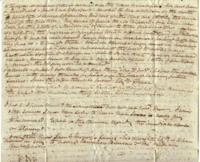
English Power of Attorney dated 1790 during the reign of King George III whereby James Makittrick Adair of Bath, a Doctor of Physic, appoints Richard Lee of Charter House in London as his Attorney before his departure for the Island of Antigua in the West Indies. Embossed revenue stamp, paper over wax seal, signature of witness and Mr. Adair.
Bid on this Item
Bid on this Item
Sunday, October 04, 2009
Last Will & Testament of John Matthew Quantock of Somerset County, England.
The Last Will & Testament from the Estate of John Matthew Quantock of Somerset County, England is up for sale on Ebay. Dated: Mar. 2nd,1864.
Saturday, January 24, 2009
Kent County, England1688, Andrews / Kemsley Family
This document is part of a collection relating to the Andrews / Kemsley family of the County of Kent, England.
"I desire you to take notice that I am sued as a casual exector for coming into the -------(unclear)----- Mencond in this declarcon wherein I have no title nor doe I claim to haue any estate or interest therein and am informd that you or some of you doe. I wish you therefor forthwith to appeare in his mats court of comon pleas at westm and to take upon you the defense of the suite in your owne names. Otherwise I will suffer a judgement to be had aft me by which you may be put from your posession without trial of you title. If you haue any wehreof I desire you to take notice from your friend Thomas.
27 Aprill 1688
Thoma Collet, John Millis, James Newell, Ralph Shelman, Widow West.
This Kent County, England document is up for sale on Ebay. Item number: 180321415609.
Saturday, January 19, 2008
1887 VELLUM MORTAGE DOCUMENT - MIDDLESEX, ENGLAND
1887 VELLUM MORTGAGE AND SATISFACTION DOCUMENT BETWEEN CHARLES HARLING COMYNS OF FAIRVIEW HOLLY PARK, NEW SOUTHGATE IN THE COUNTY OF MIDDLESEX OR SILVERSMITH AND THE IVY BUILDING SOCIETY OF THE PRINCE ALBERT TARERN WHARFEDALE ROAD KINGS CROSS IN MIDDLESEX,
Saturday, July 30, 2005
1845 letter Elizabeth Pease, Abolitionist Quaker to James Fuller NY Underground Railroad
Important 1845 British Feminist ABOLITIONIST Quaker letterA Lengthy Letter from Elizabeth Pease One of the Leaders of the British Anti-Slavery Movement, to a Station-owner on the Underground Railroad in New York
A long, substantial letter dated Darlington (England), July 29, 1845, from the staunch British anti-slavery advocate and Quaker Elizabeth Pease, to James C. Fuller of Skaneateles, New York (near Syracuse), who with his wife ran a station for escaped slaves on the Underground Railroad.
The letter illuminates the tensions within the Society of Friends on both sides of the Atlantic regarding slavery. Elizabeth is especially troubled by a deputation of British Friends about to embark from England in order to quell a schism taking place in Indiana between anti-slavery Quakers and traditional “organizationists.” Her interactions with the members of the delegation have convinced her that they are merely going in order to restore the status quo, and have no intention of allowing the slavery question to insert itself into the Society’s doctrine. Her instincts were correct: the deputation had little if any effect on the troubles in Indiana.
She details a meeting in which she is “put down” for raising the slavery question, and also touches on a number of other “hot button” issues of the time, including poverty in England (“there is as great a prejudice against poverty in England, as there is against colour in America”), women’s voting rights, and the death penalty.
Elizabeth Pease, the daughter of Joseph Pease and Elizabeth Beaumont, was born in 1807. In her early twenties, she became the leader of the Women's Abolition of Slavery Society in Darlington. In March 1838, she joined with Jane Smeal of Glasgow, to publish a pamphlet, Address to the Women of Great Britain, urging women to organize female anti-slavery associations. Elizabeth also believed that anti-slavery societies should allow women to speak at public meetings.
Elizabeth supported the campaign for the 1832 Reform Act which enabled her father, Joseph, to become Britain's first Quaker member of the House of Commons. However, unlike most middle-class reformers, Elizabeth was not satisfied with this measure and along with her close friend, Anne Knight, became a supporter of the Moral Force Chartist movement.
Elizabeth was in close contact with the Chartists in Darlington and helped to distribute their literature. In a letter to her friend, Anne Warren Weston, Elizabeth pointed out that some of her friends considered her to be "ungenteel" and "vulgar" because she was a supporter of universal suffrage.
Elizabeth, the most radical of the Pease family, believed that most of the problems afflicting British society were due to "class legislation". She supported workers who went on strike and defended those who attacked factories in Lancashire and Yorkshire in 1842.
She was a member of the Peace Society and the Temperance Society, and also took part in the anti-vivisection campaign. In 1853 she married John Pringle Nichol, a professor of astronomy at the University of Glasgow. As Nichol was a Presbyterian, Elizabeth was expelled from the Society of Friends. She and her husband moved to Edinburgh where she lived until her death in 1897.
The letter is on a very large sized sheet, which measures about 16 x 10 inches when unfolded, and she has written on just about every blank space. It was sent via the Cunard line, and she is sure to note that it is a "Single Sheet," as customers were charged for each sheet.
Thanks to Laurel Cooper for submitting this letter to The Paper Trail
Friday, November 26, 2004
1854 English passport - Sophie Anne Noble
1854 English passport. Number 9603, it was issued to Miss Sophie Anne Noble (British subject) by George William Frederick, Earl of Clarendon.
Leather cover is embossed with the name of the person but has suffered some damage. Inside, the passport opens out to 15” x 9” and has the earl’s signature and various Foreign Office stamps.
On the reverse is a red wax seal and endorsement showing Miss Noble visited Austria – via Dresden 1856. There’s also a police stamp for Breslau dated 1855
Subscribe to:
Posts (Atom)
